
Research
Our lab's interest and focus is heavily on synthesis. With the powerful tool of synthesis in hand, we can make molecules regardless of their sizes (either small organic molecules or polymers) and play around with their structures, functionalities and properties. Following are the detail area of our research directions.
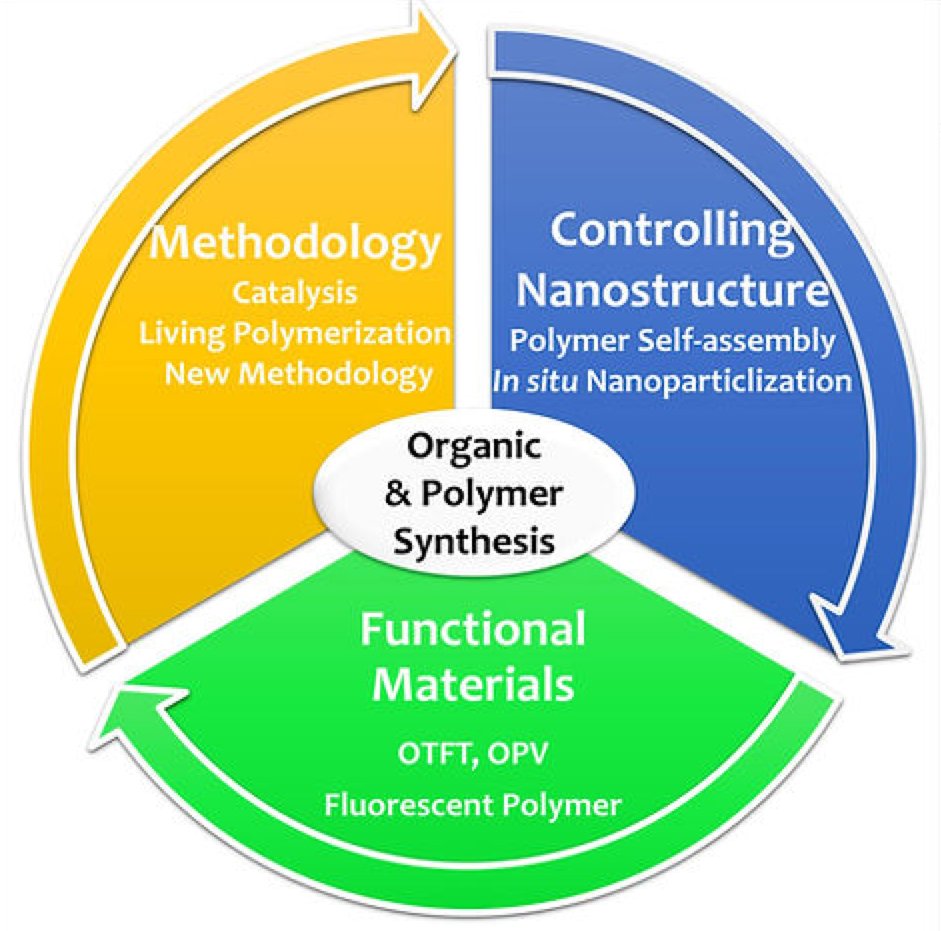
Firstly, new methods to prepare organic and polymer materials will be investigated. Selective bond formations on both small and macromolecules will be studied. Catalysis and metal-mediated reactions are the main candidates. Tandem catalysis to rapidly build up the complex molecules is also one of the goals.
Secondly, using dendrimers and polymers, we can control their nano-structures. Living polymerization, and synthesis of various polymer archetectures, such as graft, star and hyper-branched polymers are of interests.
Lastly, using the powerful tool of synthesis, we can contribute to the fast growing field of organic electronics where organic materials are the key components of electronic devices. New materials will be applied to OTFT, organic memory and solar cell devices. In short, our lab synthesize molecules and materials by new methods and try to control their nano-structures and to apply them to real-world applications.
Methods to Prepare Organic and Polymer Materials
- Cyclopolymerization of α,ω-Diynes, e.g.
- 5- or 6-Membered Rings from 1,6-Heptadiynes polymerization
- 5- or 6-Membered Rings from 1,6-Heptadiynes polymerization
- Cascade Metathesis Polymerization, e.g.
- Multiple Olefin Metathesis Polymerization (MOMP)
- Tandem Olefin Metathesis/Metallotropic 1,3-Shift (M&M) Polymerization
- In Situ Nanoparticlization of Conjugated Polymer (INCP), e.g.
- Polymer Self-Assembly into Fractal Nanostructured in Solution
- Light-Induced Crystallization-Driven Self-Assemby (CDSA)
- Nanoribbons with Tunable Length and Width via CDSA of a Homopolymer
- Ultrasonic Degradation of Denpols
- Suzuki-Miyaura Catalyst-Transfer Polycondensation (SCTP)
- Direct C-H Amidation Polymerization (DCAP)